
Loud hum at the toe-kick
Usually the condenser fan fighting a dust-loaded coil. A cleaning often solves it; a worn fan motor needs replacing.
Sound symptom · Sunnyvale & Santa Clara County
A Sub-Zero is one of the quietest things in the house, so a new buzz, hum, rattle or whine stands out. The good part: the sound is half the diagnosis. Where it is loudest, and when it happens, usually point straight at the part involved.
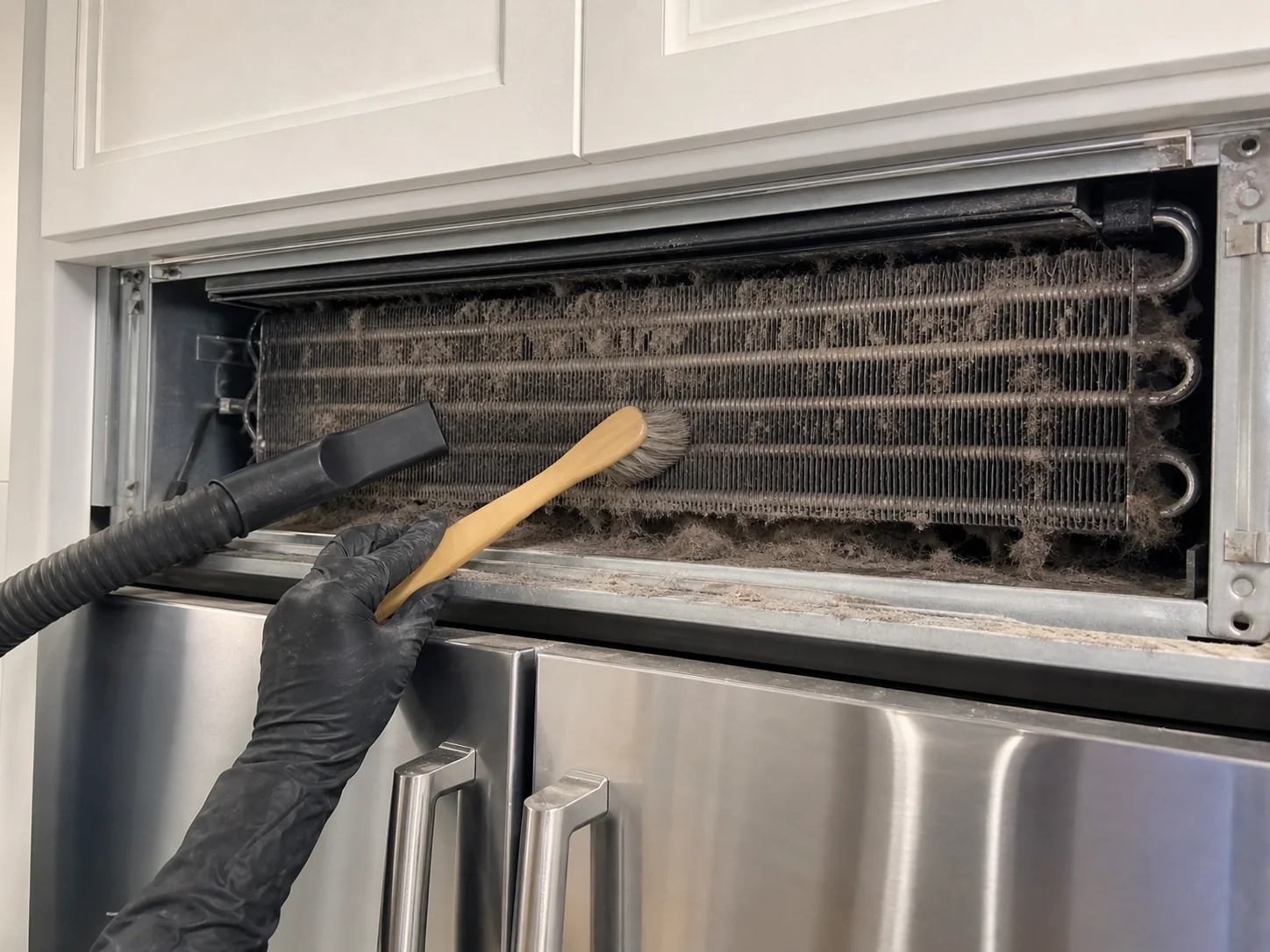
There is a reason noise complaints cluster the way they do in Sunnyvale. The mid-century ranch homes around Birdland and Ponderosa, and the Eichler tracts near Fairbrae, tend to have open kitchens with hard floors and few soft surfaces to absorb sound, so a hum that would disappear in a carpeted, partitioned house instead fills the whole room. The larger estate kitchens off Fremont Avenue add a second twist: the built-in is set flush into heavy millwork, and that cabinetry passes vibration straight into the great room like a soundboard. Same appliance, louder house.
Start by treating the noise as evidence rather than a nuisance. The two fans, the compressor, the ice maker and ordinary defrost all live in different places and make different sounds, so location and timing narrow the field fast. A noise loudest down at the toe-kick almost always comes from the condenser fan or the compressor, both of which sit in the lower machine compartment. A noise loudest from inside the cabinet usually belongs to the evaporator fan that circulates cold air, or to the ice maker cycling. And a soft gurgle that arrives only after a cooling cycle finishes is refrigerant settling — completely normal, and nothing to fix.
The most common culprit in town is the simplest. Sunnyvale summers are dry and dusty, and that fine dust settles into the condenser behind the lower grille over a couple of seasons. As it builds, the condenser fan has to push harder and can begin clipping the buildup, which produces the loud, constant hum people most often call about. A thorough cleaning frequently ends it with no parts at all — the same reason we put condenser care on the maintenance calendar. When a fan motor itself is wearing out, the sound shifts to a grind, rattle or whine, and the fix is a serial-matched motor and, sometimes, a fresh mounting clip to kill the vibration.
The noise worth taking seriously is a deep electrical buzz. Owners often assume it is the compressor and brace for the most expensive repair on the unit, but just as often it is a failing start relay — a small, affordable part. That is exactly why we measure amp draw before quoting anything major: the difference between a relay and a compressor is the difference between a routine visit and a sealed-system job, and you deserve to know which one you are facing before you pay for it. If the buzz comes with a cabinet that is warming or a unit that will not restart, call sooner; otherwise a prepared appointment is fine.
Name the sound
Usually the condenser fan fighting a dust-loaded coil. A cleaning often solves it; a worn fan motor needs replacing.
The evaporator fan that circulates cold air is wearing or its mount is loose. We replace the motor and isolate the vibration.
Often a failing start relay, not the compressor. We confirm with an amp-draw reading before any major quote.
Frequently the ice maker filling or harvesting on schedule. If it clicks without ever making ice, the module is the suspect.
Flush millwork transmits buzz into the room. A loose mount, an unlevel unit, or something resting against the cabinet is often the cause.
Refrigerant settling as cooling stops. This one is normal — no repair required.
Before you book
If the sound turns out to be a deep buzz with poor cooling, move on to sealed-system & compressor evidence — that page covers when a noise really does point at the compressor.
Planning ranges
These are planning ranges for Sunnyvale; the final price depends on the part, the model and cabinet access.
| Job | Range | What it covers |
|---|---|---|
| Service call & diagnosis | $89 | Credited to the repair once approved |
| Condenser cleaning | $ | Most common fix for a new summer hum |
| Condenser or evaporator fan motor | $$ | Grinding, rattling or whining fan |
| Start relay / electrical | $$ | Deep buzz that is not the compressor itself |
| Sealed-system / compressor proof | $$$ | High end, only after amp-draw evidence |
See the Sunnyvale repair cost guide for the wider picture, and if an alarm or error code is showing, capture it before clearing.
Customer reviews
★★★★★
A loud hum started filling our open kitchen every afternoon. He pulled the lower grille, found the condenser fan blade clipping a blanket of summer dust, cleaned and checked the bearing draw, and the room is quiet again. No parts needed.
★★★★★
Our built-in had a rattle that came right through the flush cabinetry into the whole great room. He traced it to a worn evaporator fan and a loose mounting clip, replaced the motor and isolated the vibration. Night and day difference.
★★★★★
Heard a deep buzz and worried it was the compressor. He measured amp draw, confirmed the compressor was fine and pinned it on a failing start relay instead. Saved us from a needless major repair and explained every step.
FAQ
A soft gurgle or trickle after a cycle, a quiet fan whir, and an occasional click from the controls are all normal. What is worth a look is a loud constant hum, a grinding or rattling fan, a buzz that grows over weeks, or a new vibration you can feel through the cabinet. The kind of sound is itself the first clue to which part is involved.
Two reasons. The mid-century ranch and Eichler homes here often have open, hard-surfaced kitchens that carry sound, and the larger estate kitchens off Fremont Avenue tend to build the unit flush into millwork that transmits vibration into the room. A noise that would vanish elsewhere becomes the loudest thing in the house.
Yes, and it is the most common cause we find. Sunnyvale's dry summers pack the toe-kick condenser with fine dust; the fan then works harder and can clip the buildup, producing a loud hum or whir. A thorough cleaning often solves it with no parts at all.
Not always. A deep buzz can be a failing start relay rather than the compressor itself, which is why we measure amp draw before quoting anything major. If the buzz comes with a warm cabinet or a unit that will not restart, call sooner so food does not spoil.
It begins with a flat $89 service call, credited toward the repair. A condenser cleaning is the low end; an evaporator or condenser fan motor is mid-range; a start relay or sealed-system finding is quoted only after electrical proof. You approve a written price before any work.
Independent service. Sunnyvale Sub-Zero Repair is an independent repair company. It is not affiliated with, authorized by, or endorsed by Sub-Zero Group, Inc.; brand names identify the appliances we service only.
Describe the sound and where it is loudest, and you will have a clear price before any work begins.